The Operating System is one of three core operating layers — alongside the Cash & Forecasting Layer and the Leadership Cadence Layer — that create control in growth-stage and private equity-backed businesses.
Context
Most growth-stage and private equity-backed businesses do not fail because of flawed strategy.
They fail because strategy does not translate into consistent, disciplined execution.
Revenue scales. Headcount expands. Geographic footprint grows. But the way decisions are made, metrics are defined, and performance is tracked rarely evolves at the same pace. Without a defined operating system, decision rights blur, metrics fragment across functions, and execution becomes unpredictable as complexity grows.
The symptoms are consistent: five people in a room with five different revenue numbers. Margin that looks healthy until someone agrees on what is in it. Hiring decisions made against aspirational unit economics. AI initiatives that stall because the underlying operating model is too ambiguous for automation to act reliably on.
These are not data problems or talent problems. They are operating system problems — and they compound quietly until they become crises.
The Operating System Architecture
This framework is not a set of meetings or a reporting pack. It is the execution architecture of the business.
Each component removes a specific form of ambiguity: what the numbers mean, who owns decisions, when escalation happens, how resources are allocated, and which signals actually matter.
That is why this framework improves execution immediately while also preparing the company for automation and AI-assisted decision making.
Core Components
A durable operating system has six components. Together they turn strategy into repeatable execution and create the clarity layer required for trustworthy reporting, consistent decisions, and viable AI deployment.
1. Metric Definitions and Source-of-Truth Mapping
Before metrics can guide decisions, they must be explicitly defined.
This means writing down — precisely — what each critical metric means in this business: what is included, what is excluded, how it is calculated, and which system is the authoritative source. Revenue. Gross margin. Churn. Qualified pipeline. Each one defined, owned, and documented.
When five people in a leadership team give five different revenue numbers for the same month, the business does not have a data problem. It has a definitions problem. The absence of shared metric definitions is one of the most common and most costly operating failures in scaling companies — and the most straightforward to fix.
Every critical metric requires four things: an explicit calculation, a documented set of inclusions and exclusions, a declared source of truth, and a named owner who maintains the definition and resolves conflicts when systems disagree.
2. Metrics Hierarchy — Team to Board
Performance visibility must cascade logically through the organisation.
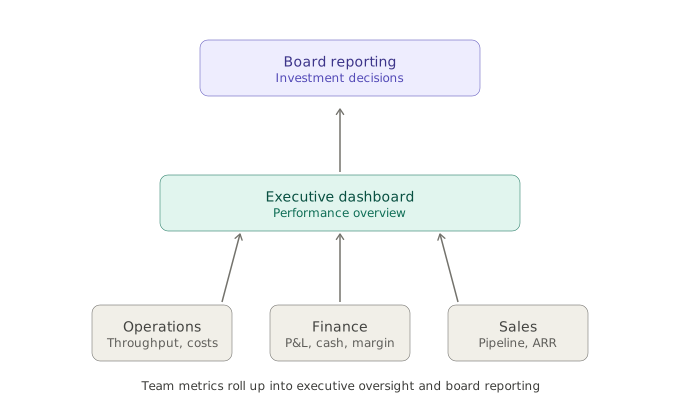
Each team owns a defined set of operational metrics. Those roll up into functional dashboards, which consolidate into executive-level performance oversight, which feeds board reporting tied directly to investment decisions.
When this hierarchy is properly installed, what a frontline team reviews weekly directly informs executive trade-offs and board conversations. Nothing is disconnected from financial impact. And the board pack becomes a formatted export of data already used to run the business — not a separate exercise assembled under deadline pressure.
3. Unit Economics Discipline
Growth must be measured by margin, not just revenue.
The operating system must define how contribution margin is measured, how shared costs are allocated, and what performance thresholds trigger intervention. Variance must be actionable — not informational.
Unit economics discipline is also the foundation for rational headcount decisions. A business that does not know its contribution margin per customer, revenue per headcount, or cost per unit of delivery cannot determine whether a hire accelerates the business or taxes it. Headcount added against aspirational unit economics creates a fixed cost burden that does not adjust when revenue comes in below plan.
4. Decision Rights and Escalation Paths
Execution slows when authority is ambiguous.
A durable operating system defines who owns which decisions, which trade-offs require escalation, and what predefined thresholds trigger executive or board involvement.
Decision rights should not depend on personality, tenure, or informal influence. They must be explicit and written down. When they are, escalations decrease, decision velocity increases, and the founder or CEO stops being the bottleneck for decisions that should be made two levels below them.
5. Headcount Sequencing Against the Operating Model
Headcount decisions are the most expensive and least reversible operating decisions a scaling company makes. They require a higher standard of operating clarity before execution than any other category of cost commitment.
Before any significant hire, three conditions should be true: the role is defined at the outcome level — not as a job description, but as a set of owned outcomes and 90-day success metrics. The operating context is mapped — the process the hire will work within, the systems they will use, and the ownership boundaries that govern their decisions. And the unit economics support the decision under a realistic scenario — not the base case, but the scenario the business is currently tracking to.
Premature headcount does not accelerate execution. It adds coordination overhead and operating complexity that compounds as the business scales. The operating model must be ready to absorb the headcount before the hire is made.
6. Investment and Resource Discipline
Every initiative competes for finite resources and management attention.
The operating system defines how growth initiatives are evaluated, how expected return profiles are validated, and how resources are allocated in alignment with margin protection and liquidity strategy. Without this discipline, capital and attention flow to the initiatives with the most vocal advocates rather than the strongest operating rationale.
Control in Practice
Architecture alone is insufficient without enforcement.
The system must define clear variance thresholds, escalation rules tied to financial impact, canonical metric definitions, and reporting that connects operational drivers to cash and investment outcomes.
Metrics only matter if they change behaviour. Without clear ownership, canonical definitions, and escalation logic, performance visibility stays descriptive rather than directional — and AI systems have no reliable operating context to act on.
Where It Breaks
When the operating system is underdeveloped, predictable failure modes emerge.
Metric disagreement. Five people, five revenue numbers. The business is not lying — it has not made the definitions decisions. Every downstream system and every downstream decision inherits that inconsistency.
Founder bottleneck. Decision rights are informal and concentrated. Every non-trivial decision escalates upward because ownership and thresholds are unclear. Execution slows to the rate at which one person can process and respond.
Premature headcount tax. Hires made before roles are defined, processes are mapped, or unit economics are confirmed. The cost is paid in margin compression, management overhead, and — when revenue comes in below plan — restructuring.
AI initiatives that disappoint. Automation is deployed on top of undefined workflows, unstable metrics, and inconsistent operating rules. AI does not resolve ambiguity — it amplifies it. The pilot fails not because the technology is wrong but because the operating model was not ready for it.
These are system gaps, not talent gaps. They require structural correction.
Implementation Sequence
Step 1 — Diagnose the operating model. Review metric integrity, ownership clarity, and decision flow. Identify where definitions are absent, where systems conflict, and where escalation is informal.
Step 2 — Define metrics and source-of-truth mapping. Write explicit definitions for every critical metric. Declare the canonical source for each. Assign an owner.
Step 3 — Map escalation pathways. Define financial impact thresholds and intervention triggers. Who decides what, at what threshold, and with what information.
Step 4 — Build the metrics hierarchy. Eliminate noise. Enforce alignment from team metrics to executive dashboard to board reporting. Confirm the same data flows through all three levels.
Step 5 — Install unit economics governance. Define contribution margin visibility, shared cost allocation, and variance triggers that are actionable rather than informational.
Step 6 — Sequence headcount against the model. Apply the readiness test to the hiring plan. Define roles at the outcome level before posting. Confirm unit economics under realistic scenarios before committing.
Step 7 — Lock weekly execution cadence. Create disciplined variance review and action closure. The cadence enforces the operating system — without it, the definitions work degrades over time.
Step 8 — Align board reporting. Ensure investor reporting reflects operational reality and flows directly from the weekly operating data rather than being assembled separately.
Why This Matters for AI
Most companies are attempting to deploy AI on top of fragmented operating models. That rarely works.
AI systems require consistent metric definitions, stable entity models, reliable source-of-truth systems, and clear decision rules. Those are not AI problems — they are operating system problems.
Companies that build a clear operating system create the context layer that AI can actually operate on. Operational clarity becomes a strategic advantage long before the company begins discussing AI transformation.
When This Layer Is Critical
The Operating System becomes essential during post-investment stabilisation, rapid headcount growth, multi-site or multi-market expansion, post-merger integration, and pre-IPO infrastructure development.
At these points, ambition is not the problem. Operational clarity is.