The Forecasting Architecture
Most post-raise forecasts are built backwards from targets. A driver-based forecast is built forwards from operating reality — and the difference in usefulness is not marginal.
A target-based forecast starts with the number the business needs to hit and works backwards to assumptions that produce it. It looks credible. It is internally consistent. And it is wrong in ways that only become visible when the gap between forecast and reality is too wide to close without material restructuring.
A driver-based forecast starts with the operational variables the business actually controls and can observe: conversion rates, sales cycle length, average contract value, units sold, churn rate, collection timing. When any assumption changes, the cash impact is quantified immediately — and the business can respond to signals rather than to crises.
Core Components
1. Driver-Based Operating Forecast
The foundation of cash discipline is a model where revenue is built from actual operational inputs rather than from targets or from last year’s actuals plus a growth rate.
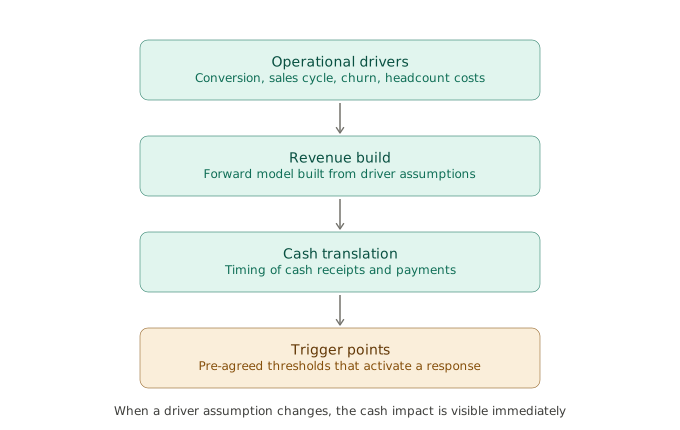
The model has three layers. Operational drivers are the variables the business controls or can observe in near-real time — conversion rates, average order value, sales cycle length, churn rate, headcount cost, collection timing. Revenue build is the output of running those drivers through the business model — not a target, but a consequence of the driver assumptions. Cash translation converts the revenue build into a cash flow view, accounting for timing differences between revenue recognition and cash collection, and between cost commitment and cash payment.
When operational performance diverges from assumptions, the cash impact is quantified automatically rather than discovered retrospectively.
2. 13-Week Cash Flow View
The 13-week cash flow view is the operational layer of forecasting discipline. It is not a strategic document — it is an operational one.
Updated weekly, it provides a rolling picture of cash in and cash out at the level of actual operating drivers. It tells the leadership team where the business is, not where it hopes to be. And it ensures that deterioration in cash position is visible early enough to respond before options run out.
Most monthly financial models obscure cash timing. Revenue recognised in month three may not be collected until month five. Headcount cost committed in month one starts compounding immediately regardless of revenue performance. The 13-week view makes these timing dynamics explicit and keeps them current.
3. Scenario Planning and Stress Testing
The base case forecast is the plan the business is trying to execute. It is not the only plan the business needs.
Scenario planning defines two or three alternative operating pictures — typically a downside case at 15–20% below base case revenue, and a conservative case at 25–30% below — and works through the cash implications of each. What does the cost structure look like under each scenario? What is the runway impact? What decisions change, and at what threshold?
Stress testing the headcount plan against the downside case is particularly important. Headcount is the highest-commitment, least-reversible operating cost a scaling company carries. A hiring plan that is only affordable at base case revenue creates a structural margin problem that does not self-correct when growth comes in below plan.
4. Defined Trigger Points
Trigger points are the mechanism that converts forecasting discipline into operating action.
A trigger point is a pre-agreed threshold that determines when the business changes its operating posture and what action follows. If conversion drops below X for two consecutive weeks, the hiring plan pauses. If runway falls below Y weeks at current burn, a formal board conversation is triggered. If gross margin falls below Z, the cost structure is reviewed.
Trigger points are not performance targets. They are decision rules — defined in advance, before the pressure of underperformance makes clear thinking difficult. They remove the ambiguity from hard decisions and ensure the business responds to signals rather than to crises.
Without trigger points, the response to deteriorating performance is improvised under pressure. With them, the response is predetermined, faster, and less likely to overcorrect.
5. Forecast Ownership and Cadence
A forecast that nobody owns is not a forecast — it is a document.
Every driver assumption in the model must have a named owner: the person responsible for the operational reality that assumption represents. The sales leader owns the conversion rate assumption. The finance lead owns the collection timing assumption. The operations lead owns the unit cost assumption.
Forecast ownership means that when an assumption is missed, the owner is accountable for both understanding why and updating the model. The forecast is reviewed weekly in the leadership operating cadence — not monthly in a finance process — so that the picture stays current rather than becoming a historical artefact.
Control in Practice
Forecasts must sit inside decision-making, not outside it.
This means weekly variance review aligned to the operating cadence, monthly recalibration of driver assumptions at executive level, and board reporting that connects operational drivers directly to cash outcomes.
Variance thresholds must trigger action, not discussion. A forecast that produces a response of “let’s watch it for another month” is not functioning as a decision tool — it is functioning as a historical record.
Forecasting discipline is not about predicting the future precisely. It is about knowing quickly when the plan is not holding and having a predetermined response ready before the situation becomes urgent.
Where It Breaks
Target-based forecasting. The model is built backwards from what the business needs to achieve rather than forwards from what the operating drivers actually support. The result looks credible and is structurally optimistic. When reality diverges from the model — which it does — the gap is discovered late and the response options are constrained.
No 13-week visibility. Monthly models obscure cash timing and produce surprises. The business does not see deteriorating cash position until it is already material.
Headcount committed against base case. The hiring plan is built against the best-case revenue scenario. When revenue comes in at 80% of plan — the common case, not the exception — the committed cost base does not adjust. Margin compresses. Runway shortens faster than any model predicted.
No trigger points. The response to underperformance is improvised under pressure rather than predetermined when thinking is clear. Hard decisions are delayed. By the time they are made, the options have narrowed.
Forecast not owned. Driver assumptions are nobody’s specific accountability. When they miss, the conversation is about what happened rather than who owns the correction and what changes in the model.
Implementation Sequence
Step 1 — Audit the current forecast. Establish whether the existing model is driver-based or target-based. Identify which driver assumptions have named owners and which do not. Assess cash timing visibility.
Step 2 — Build the driver model. Reconstruct the revenue forecast from operational inputs. Map each driver to an owner. Validate assumptions against recent actuals rather than against plan.
Step 3 — Build the 13-week cash flow view. Translate the driver model into a weekly cash flow view. Connect to actual collection and payment timing data.
Step 4 — Develop scenario cases. Build downside and conservative scenarios at defined discount levels. Work through the headcount and cost implications of each.
Step 5 — Define trigger points. For each critical driver, define the threshold at which a predetermined response is activated. Document the response for each trigger.
Step 6 — Assign forecast ownership. Name an owner for every driver assumption. Define the review cadence and the process for updating assumptions when actuals diverge.
Step 7 — Integrate with operating cadence. The 13-week view and driver variance are reviewed weekly in the leadership operating cadence alongside operational metrics — not in a separate monthly finance process.
Step 8 — Align board reporting. Ensure board reporting connects operational driver performance directly to cash outcomes. Trigger point activations and scenario changes are reported proactively rather than retrospectively.
When This Layer Is Critical
Cash and forecasting discipline becomes essential after a funding raise, during post-investment stabilisation, when headcount is scaling quickly, during multi-site or multi-market expansion, and in any environment where margin pressure is compressing the runway faster than the leadership team is tracking.
At these points, a target-based monthly model is not sufficient. The business needs a live, driver-based picture of cash that responds to operating signals in real time.